Trees bring structure, privacy and natural beauty to gardens across Corfe Mullen. However, they also require careful management. A tree that has become damaged, diseased or dangerously overgrown may threaten buildings, vehicles and anyone using the surrounding space.
Hanwell Tree Care provides professional tree surgery and tree removal in Corfe Mullen for domestic and commercial customers. Established in 1978, the company has more than 40 years of experience caring for trees throughout Dorset. Its NPTC qualified, fully insured tree surgeons can assess each tree before recommending a safe and appropriate course of action.
Whether you need to remove a dangerous tree, manage an overgrown crown or clear a stump, Hanwell Tree Care can provide practical advice and a free quotation.
Professional tree surgery in Corfe Mullen
Tree surgery covers a broad range of work intended to manage the condition, safety and appearance of trees. Although complete removal is sometimes necessary, skilled tree surgery can often resolve a problem without sacrificing a healthy tree.
The correct approach depends on the species, age, position and condition of the tree. Its proximity to buildings, boundaries and public spaces will also influence the work. Therefore, a professional assessment should always come before any significant cutting or removal.
Hanwell Tree Care provides tree surgery in Corfe Mullen for private gardens, commercial grounds and other managed outdoor spaces. The team can recommend work that responds to the individual tree and its surroundings rather than applying the same solution in every situation.
Available services include tree removal, tree felling, crown reduction, crown thinning, crown lifting, stump removal and stump treatment.
Tree removal in Corfe Mullen
Removing a mature tree requires knowledge, planning and suitable equipment. Even a relatively modest tree can weigh considerably more than it appears. Its branches may extend over roofs, sheds, fences, roads or neighbouring gardens. Furthermore, decay within the trunk can make the tree behave unpredictably while it is being dismantled.
Professional tree removal protects the surrounding property while allowing the work to proceed efficiently. Before starting, a tree surgeon will consider the tree’s condition, available working space, nearby structures and the safest method of removal.
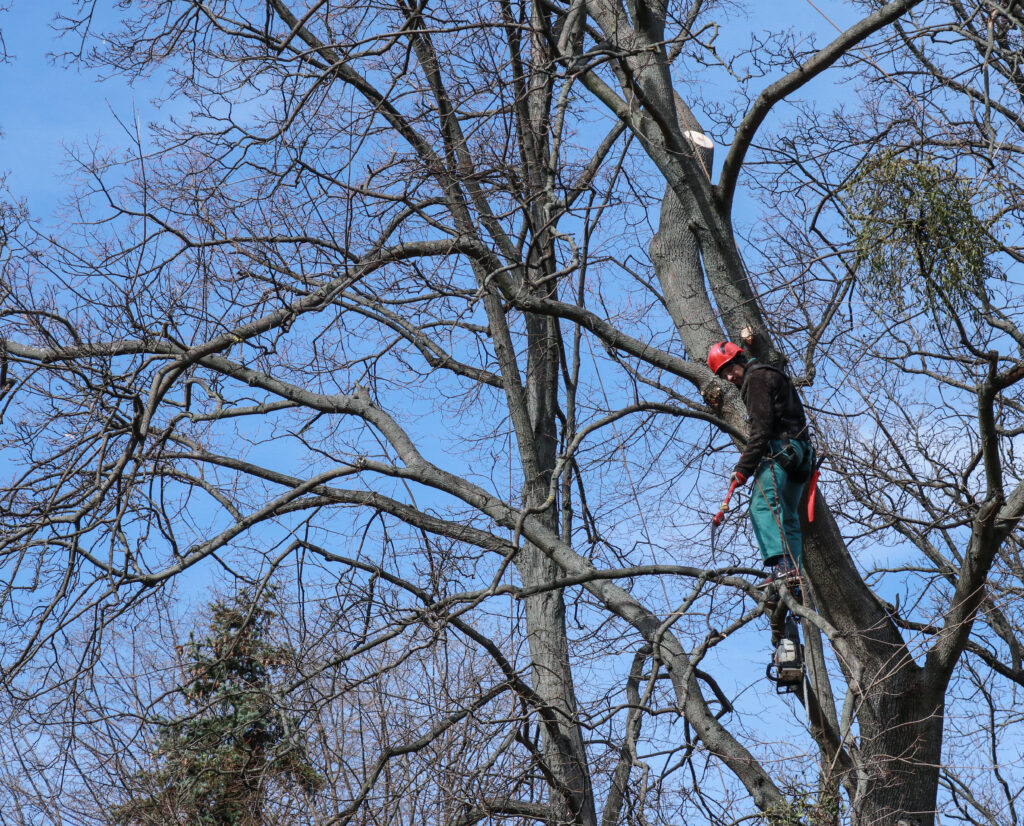
Where there is sufficient space, the team may fell the tree from ground level in a controlled direction. However, trees in restricted gardens usually require sectional dismantling. The tree surgeon removes the crown and trunk in manageable pieces, carefully controlling each section as it reaches the ground.
This method demands considerable skill. It allows the team to remove a tree from a confined position while protecting lawns, planting, buildings and boundaries wherever reasonably possible.
When might a tree need to be removed?
Removing a tree is a significant decision. A responsible tree surgeon will assess whether pruning or crown management could solve the problem before recommending complete removal. Nevertheless, there are circumstances in which felling may provide the safest or most practical solution.
The tree has died or developed serious disease
A dead tree will gradually lose its structural strength. Branches may fall without warning, while decay can weaken the trunk or roots. Some diseases can also cause irreversible decline.
An inspection can help determine the extent of the problem. If the tree cannot recover or remain reasonably safe, removal may become necessary.
Storms have caused substantial damage
Strong winds can split branches, damage unions and destabilise root systems. The full extent of storm damage is not always visible from ground level. A tree may continue standing while concealing weaknesses that could lead to further failure.
If you notice hanging branches, fresh cracks, sudden leaning or disturbed soil around the base, arrange a professional assessment promptly.
The tree threatens a building or structure
Trees growing close to houses, garages, walls and other structures sometimes become unsuitable for their location. Heavy branches may extend over a roof, while a leaning or unstable tree could create an unacceptable risk.
Removing the tree is not automatically the only answer. Crown reduction or selective pruning may provide a proportionate solution. A qualified tree surgeon can assess the options and explain which approach is most suitable.
The tree has outgrown its position
Some species eventually become too large for a modest garden. Their crowns may dominate the available space, restrict light or interfere with neighbouring properties.
Careful crown work can often manage excessive growth. However, removal may prove more practical when the tree is fundamentally unsuitable for its surroundings or requires frequent intervention to remain manageable.
The roots or trunk are unstable
Fungal growth, cavities, extensive decay and movement around the root plate can indicate structural weakness. These signs do not always mean that a tree must come down. However, they do justify a professional inspection.
Prompt advice can help you understand the risk and decide whether remedial tree surgery or removal is appropriate.
How professional tree removal works
Every tree removal project begins with an assessment. The tree surgeon examines the tree and considers its size, condition, position and surrounding hazards. Access must also be reviewed because narrow entrances and confined gardens can affect how equipment and timber move through the site.
The team then decides whether the tree can be felled in one controlled movement or needs sectional dismantling. Where appropriate, trained tree surgeons may use climbing equipment and controlled lowering techniques to manage individual branches and sections of trunk.
The precise process varies from one site to another. A tree growing in an open field presents different challenges from one standing between two houses. Therefore, a tailored plan remains essential.
Once the tree has been removed, the team can discuss the remaining stump. Depending on your plans for the space, you may choose stump removal or treatment.
Why use a qualified and insured tree surgeon?
Tree work carries serious risks. Chainsaws, heavy branches, climbing equipment and work at height require proper training. Attempting to remove a tree without the necessary knowledge can endanger people, buildings and neighbouring properties.
Hanwell Tree Care uses NPTC qualified tree surgeons and is fully insured. The company is also local authority approved and has served customers across Dorset since 1978, according to the Hanwell Tree Care website.
Choosing a qualified tree surgeon also helps ensure that the work reflects the condition and natural structure of the tree. Poor cutting can leave lasting wounds, encourage weak regrowth or damage an otherwise healthy specimen. Professional tree surgery aims to achieve the required result while respecting the tree wherever retention remains possible.
Crown work as an alternative to removal
Complete removal is not always necessary. Appropriate crown management may improve safety, control growth and help a tree sit more comfortably within its surroundings.
Crown reduction decreases the overall height or spread of the canopy while retaining its natural shape. Crown thinning removes selected branches throughout the canopy to reduce density. Crown lifting removes lower branches to improve clearance above paths, roads, gardens or buildings.
The correct form of crown work depends on the tree and the reason for intervention. Excessive or poorly planned pruning can cause significant harm. Consequently, a tree surgeon should assess the tree and recommend a suitable approach.
Stump removal after tree felling
Felling a tree usually leaves the stump and root base in the ground. Some customers choose to retain it, while others want to reclaim the area for planting, landscaping or another purpose.
A remaining stump can occupy useful space and make garden maintenance more difficult. Depending on the species, it may also produce new shoots. Stump removal or treatment can provide a neater and more practical finish following tree felling.
Hanwell Tree Care can discuss the available options as part of your quotation. Arranging the work together can simplify the process and help you plan how the area will be used afterwards.
Tree Preservation Orders and conservation areas
Before significant tree work begins, it is important to establish whether legal protection applies. A Tree Preservation Order can protect an individual tree, a group of trees or woodland. In many circumstances, work to a protected tree requires written consent from the local planning authority.
Separate controls may apply to trees within conservation areas. Subject to certain exceptions, the local planning authority generally requires six weeks of written notice before work begins. Further information is available through the official government guidance on protected trees and Dorset Council.
Requirements vary according to the tree, its location and the proposed work. Therefore, property owners should confirm the position before authorising removal or pruning. This section provides general information rather than legal advice.
Why choose Hanwell Tree Care?
Hanwell Tree Care brings more than four decades of experience to tree surgery in Corfe Mullen and the surrounding parts of Dorset. The company works with domestic and commercial customers, providing informed recommendations based on the condition of the tree and the practical needs of the site.
Customers can benefit from:
• NPTC qualified tree surgeons
• Full insurance
• Local authority approved services
• More than 40 years of experience
• Tree surgery and removal for varied sites
• Stump removal and treatment options
• Free surveys and quotations
• Local coverage across Corfe Mullen, Broadstone, Wimborne and Poole
Most importantly, the process begins with an assessment. This gives you the opportunity to explain your concerns, understand the available options and receive a quotation for the recommended work.
Frequently Asked Questions
How much does tree removal cost in Corfe Mullen?
Tree removal costs vary according to the tree’s height, condition, position and accessibility. The proximity of buildings, roads, overhead obstacles and neighbouring properties can also affect the complexity of the work. Hanwell Tree Care offers a free survey and quotation based on the individual site.
Do I need planning permission to remove a tree?
Ordinary planning permission is not always required. However, restrictions may apply if the tree is protected by a Tree Preservation Order or stands within a conservation area. Other conditions can also be relevant. Check the requirements with the local planning authority before work begins.
Can work be carried out on a tree with a Tree Preservation Order?
Work may be possible, but it will often require consent from the local planning authority unless a valid exception applies. Do not assume that poor condition automatically removes the need to follow the correct process. Seek appropriate advice before arranging the work.
Arrange a free tree surgery quotation in Corfe Mullen
Whether you need to remove an unsafe tree, manage an overgrown crown or clear an unwanted stump, professional advice can help you make the right decision for your property.
Hanwell Tree Care provides qualified and fully insured tree surgery and tree removal in Corfe Mullen. With more than 40 years of experience, the team can assess the tree, explain the available options and recommend an appropriate solution.
Contact Hanwell Tree Care today to arrange your free survey and quotation. Call the team or submit an enquiry online to discuss tree removal or tree surgery at your home, commercial premises or managed outdoor space.