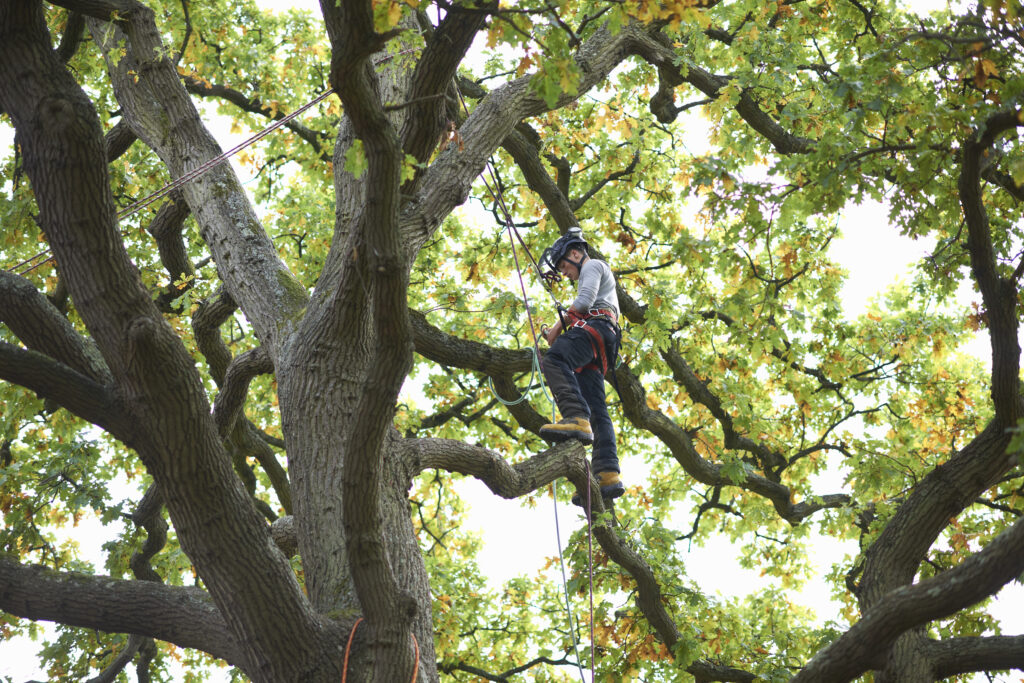
Some trees need to be dismantled in sections because there is not enough space to fell them safely in one piece. Buildings, roads, boundaries, overhead services and confined gardens can all restrict the available working area. By removing the crown, branches and trunk in carefully controlled sections, a qualified tree surgeon can manage each part of the tree while protecting the surrounding property.
Hanwell Tree Care provides professional tree dismantling across Dorset, including Poole, Bournemouth and the surrounding South Coast. Every project begins with an assessment of the tree, its condition, the available access and the features around it.
To arrange a free survey and quotation, contact Hanwell Tree Care to discuss the tree and any concerns about its condition or location.
What Is Sectional Tree Dismantling?
Sectional tree dismantling is a controlled method of removing a tree one part at a time. Rather than making a cut at the base and allowing the complete tree to fall, a qualified tree surgeon removes individual branches before dividing the remaining trunk into manageable sections.
The precise method depends upon the tree and its surroundings. Smaller pieces may be lowered directly to the ground, while larger branches or trunk sections may require ropes and specialist rigging equipment. These systems allow the team to control how each section moves and where it reaches the ground.
The Health and Safety Executive identifies ropes and rigging systems for lowering branches as lifting equipment used within arboriculture. It also states that lifting operations must be properly planned, appropriately supervised and carried out safely. HSE
Sectional dismantling requires knowledge of tree structure, weight, balance and the forces created as each piece is removed. It should therefore only be undertaken by people with suitable training, experience and equipment.
Why Can Some Trees Not Be Felled in One Piece?
Felling a complete tree requires sufficient clear space for the tree to descend without striking buildings, people, vehicles, services or other valuable features.
This space is rarely available in a typical residential garden. Mature trees in Poole and Bournemouth may stand between houses, beside conservatories or close to neighbouring boundaries. Others grow beside roads, driveways, garages, sheds or established planting.
Even where a garden appears reasonably spacious, the height and spread of the tree may make conventional felling unsuitable. The tree surgeon must consider more than the position of the trunk. The full canopy, the tree’s natural lean and the distribution of weight throughout its branches can influence how it would fall.
Sectional dismantling allows the tree surgeon to retain greater control over the removal. The tree is gradually reduced within its existing footprint rather than being allowed to descend across the surrounding space.
Restricted Access and Confined Gardens
Access is one of the principal reasons a tree may need to be dismantled in sections.
Properties across Dorset can have narrow side passages, enclosed rear gardens and limited access for machinery. There may be no direct route between the tree and the road. Garden walls, fences and neighbouring land can impose further restrictions.
A professional assessment helps establish:
- How the tree surgeons can enter and leave the site
- Where equipment can be positioned
- Whether branches can be lowered directly
- How timber and green waste can be removed
- Which parts of the property require protection
- Whether neighbouring access needs to be considered
Sectional dismantling does not depend upon having an open space in which to fell the complete tree. Instead, the work can be planned around the dimensions and practical limitations of the site.
If a large tree occupies a small or enclosed garden, Hanwell Tree Care can assess the available access and advise whether controlled dismantling is appropriate.
Trees Close to Homes and Other Structures
A tree may appear healthy but still require careful removal because of its position. Branches may extend above roofs, garages, conservatories, garden rooms, fences or neighbouring land.
Allowing heavy timber to fall freely in these circumstances could damage the features below. A tree surgeon may instead attach a suitable lowering system to a branch before it is cut. The branch can then be guided into a chosen area in a controlled manner.
The same principle may be used as the trunk is reduced. Rather than dropping large pieces from height, the team can divide the stem into sections suited to the available landing area and the capacity of the equipment.
The approach must be planned for the particular tree. Timber is extremely heavy, and the forces involved can be considerable. The size of each section, the position of anchor points and the condition of the remaining tree all require professional judgement.
Diseased, Damaged and Unstable Trees
The physical condition of a tree can also determine how it should be removed.
Disease, decay, storm damage or structural weakness may affect the strength of branches and unions. A tree may have a split stem, a damaged crown or areas of dead wood. In other cases, changes around the roots or a developing lean may cause concern.
However, an unusual appearance does not automatically mean that the whole tree requires removal. Pruning, crown work or the removal of selected branches may provide a more suitable solution. A professional inspection allows the tree surgeon to consider the condition of the tree before recommending any work.
Where removal is justified, the dismantling method must account for any weakened timber. A compromised tree may not provide the same dependable anchor points as a healthy specimen. The tree surgeon may need to adapt the sequence of work or consider whether other access equipment is appropriate.
Hanwell Tree Care undertakes tree surgery, felling and emergency work involving fallen and storm damaged trees throughout its Dorset service area.
How Is a Tree Dismantled in Sections?
No single method is suitable for every tree, but the process will usually begin with a survey of the site.
The tree surgeon considers the species, size, structure and condition of the tree. Nearby buildings, roads, boundaries, services and garden features are also examined. The assessment helps the team decide how the work should be organised and which equipment may be required.
The removal may then involve:
Establishing a suitable working area around the tree
Accessing the crown using an appropriate climbing system or other suitable equipment
Removing smaller branches to create working space
Cutting larger limbs into manageable sections
Lowering sections with ropes where they cannot be allowed to fall freely
Reducing the main stem from the top downwards
Processing and removing the resulting timber and green waste as agreed
Grinding the remaining stump if this service forms part of the quotation
This controlled sequence allows the size and weight of the tree to be reduced gradually. The exact process will vary according to the property and the condition of the tree.
Will the Tree Stump Also Be Removed?
Tree dismantling normally leaves the stump and root system in the ground unless stump removal has also been arranged.
Some customers are content to retain a low stump, particularly in a less visible part of the garden. Others require it to be removed because it occupies useful space, interferes with landscaping or presents an inconvenience.
Stump grinding reduces the stump below ground level using specialist machinery. Whether it is suitable will depend upon the size and position of the stump, underground obstructions and access for the equipment.
Hanwell Tree Care provides stump grinding alongside its wider tree removal services. Customers can discuss this during the initial survey so that the quotation clearly reflects the complete work required.
Does Permission Need to Be Checked Before Tree Removal?
Permission may be required before a tree can be dismantled or felled.
A Tree Preservation Order can protect an individual tree, a group of trees or woodland. Subject to limited exceptions, work such as cutting down, topping, lopping or uprooting a protected tree requires written consent from the local planning authority. GOV.UK
Trees within conservation areas can also be subject to specific requirements. Where no separate Tree Preservation Order applies, the local planning authority will generally need to receive six weeks of notice before qualifying work begins. Exceptions can apply, so the circumstances should always be checked carefully. GOV.UK
The presence of disease or decline does not necessarily remove the need for consent. It is therefore sensible to establish whether the tree is protected before arranging the work.
A professional tree surgeon can help identify the questions that need to be addressed and ensure that the proposed work is described accurately.
Tree Dismantling in Poole and Bournemouth
Properties in Poole and Bournemouth range from compact urban homes to larger grounds with mature trees. Access may be limited, and established trees can stand close to houses, roads, driveways and neighbouring gardens.
Hanwell Tree Care provides professional tree removal in Poole and tree surgery in Bournemouth, as well as throughout the wider Dorset area.
If a tree has become damaged, unstable, unsuitable for its position or difficult to manage, an inspection can establish whether removal is necessary. Where there is insufficient space for conventional felling, sectional dismantling may provide a controlled means of removing it.
Frequently Asked Questions
Can a large tree be removed from a small garden?
Yes, it is often possible to remove a large tree from a confined garden by dismantling it in controlled sections. The method will depend upon the condition of the tree, access to the property and the position of nearby structures.
Why are ropes used during tree dismantling?
Ropes and rigging systems can help control branches and trunk sections that cannot be allowed to fall freely. They enable trained tree surgeons to lower timber into a suitable area while managing its movement.
Does a tree always need to be removed if it is damaged?
No. The appropriate solution depends upon the nature and extent of the damage. Pruning, crown work or the removal of selected branches may sometimes be sufficient. A professional inspection is needed before deciding upon removal.
Arrange a Tree Assessment in Dorset
If you are concerned about a large, damaged or awkwardly positioned tree, the first step is to obtain professional advice.
Hanwell Tree Care can inspect the tree, assess the surrounding property and explain the work that may be appropriate. If removal is required, the team can determine whether the tree should be dismantled in sections and prepare a quotation based upon the circumstances of the site.
To arrange a free survey and quotation for tree dismantling in Dorset, Poole, Bournemouth or elsewhere along the South Coast, contact Hanwell Tree Care or call 01202 509977.