A magnificent mature tree can give a garden something that cannot be bought from a catalogue or created in a season. It lends height, character, privacy and a sense of permanence. A large oak, beech, pine or cedar may have occupied its place for generations, becoming as much a feature of the property as the house itself.
Yet mature trees cannot simply be taken for granted. Their size makes them resilient in many respects, but it also means that small problems can become significant ones if they are overlooked for too long.
Keeping a large garden tree healthy is chiefly a matter of observation, sensible management and protecting the conditions in which it grows. Regularly inspect the canopy, trunk and surrounding ground, protect the root area, avoid unnecessary pruning, provide water during severe dry periods and seek advice from a qualified tree surgeon when you notice damage, decay or an unexpected change in the tree.
For homeowners in Wimborne, Poole, Bournemouth, Verwood and Ferndown, looking after mature trees is often less about constant intervention and more about knowing when to leave a tree alone and when expert attention is justified.
Start With Regular Observation
You do not need to be an arborist to become familiar with your own trees.
Indeed, one of the advantages a homeowner has is the opportunity to see a tree throughout the seasons. You know how full its canopy usually appears in summer, when it normally comes into leaf and whether its branches have always grown in a particular direction.
Changes are therefore worth noticing.
Look occasionally at the tree as a whole rather than concentrating only on its leaves. Has one part of the crown become unusually sparse? Have substantial dead branches appeared? Is there fresh cracking around a major branch union? Has the tree developed a new lean, or has the soil lifted around its base?
Guidance on mature tree care similarly advises owners to pay attention to unusual changes such as dead branches, discoloured foliage and structural alterations, and to obtain professional advice when something appears abnormal.
A change does not necessarily mean that a tree is dangerous. It means that the change deserves consideration.
Know the Signs of a Tree That May Be Struggling
Healthy trees are not always visually perfect. Mature specimens naturally develop deadwood, cavities, scars and irregular forms as they age.
The important distinction is between ordinary ageing and a change that could indicate declining health or structural weakness.
Warning signs can include noticeably thinning foliage, premature leaf loss, significant areas of dead growth, cracks in substantial branches, loose bark, cavities, fruiting bodies from fungi and damage around major roots.
Fungal growth deserves particular care. The presence of a fungus does not automatically mean that a tree must be removed. Different fungi interact with trees in very different ways, and correct identification matters.
Likewise, a hollow tree is not automatically an unsafe tree.
This is where a professional tree surgeon can be valuable. Rather than drawing conclusions from a single symptom, an experienced professional can consider the entire tree, its species, age, structure, location and surroundings before recommending what should happen next.
Prune With Purpose Rather Than Habit
One of the most persistent misconceptions in garden maintenance is that every large tree benefits from regular heavy pruning.
It does not.
A mature tree should generally be pruned for a reason rather than simply because another year has passed.
Pruning may be appropriate to remove dead or damaged growth, manage particular branches, improve clearance or address a genuine structural concern. Good tree surgery aims to achieve a specific result while retaining an appropriate natural form.
Excessive pruning can create problems rather than solve them. Removing too much living material reduces the tree’s ability to produce energy and may stimulate vigorous replacement growth.
Large branches also require particular care. Cutting substantial limbs is not ordinary garden maintenance. Their weight, position and the forces involved can make seemingly straightforward work extremely hazardous.
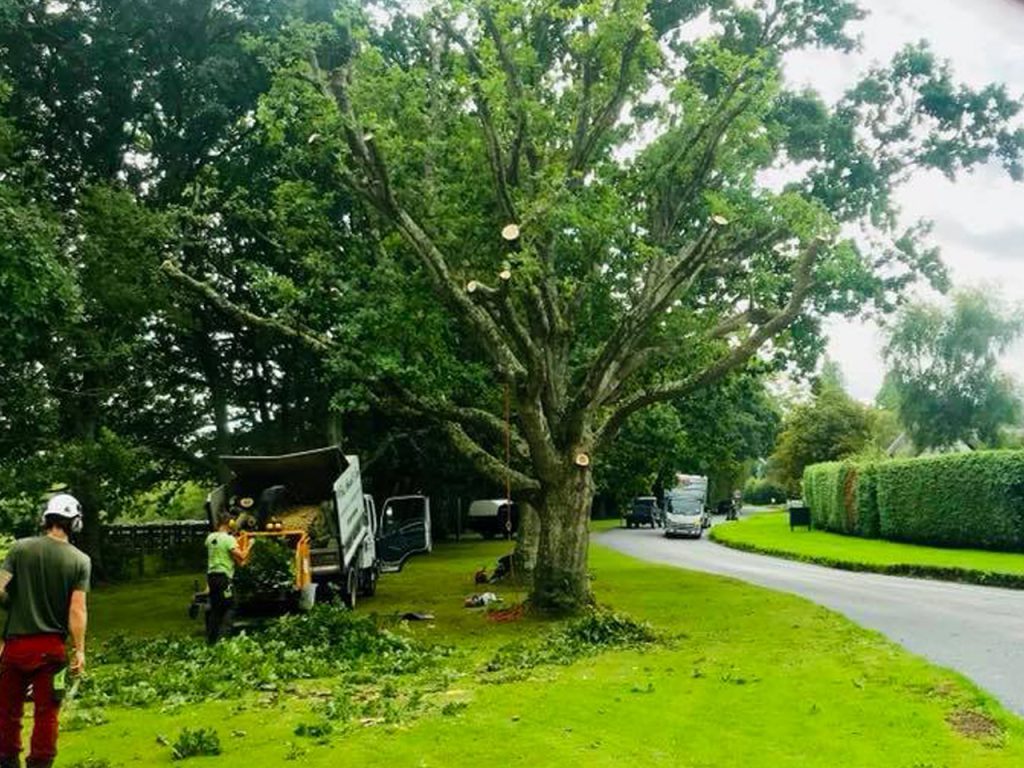
Hanwell Tree Care provides professional tree surgery and felling alongside crown work throughout Dorset, including Wimborne, Poole, Bournemouth, Verwood and Ferndown. The company states that its staff are qualified through City and Guilds NPTC for both ground and aerial tree work.
Consider Crown Reduction Carefully
Sometimes the issue is not one troublesome branch but the overall size or spread of a tree.
Crown reduction involves reducing the height or spread of the canopy while retaining an appropriate framework and natural appearance.
It can be useful where a mature tree has become too large for its surroundings, where selected branches require management or where there is a sound arboricultural reason to reduce parts of the crown.
The quality of the work matters enormously.
A thoughtful crown reduction is very different from indiscriminately cutting branches back to arbitrary points. A tree surgeon should consider species, form, branch structure and the amount of foliage that can reasonably be removed.
Hanwell Tree Care lists crown work among its principal tree services and provides reduction and shaping services across its local operating area.
Remember That Much of the Tree Is Underground
When people think about tree health, they naturally look upwards.
Yet what happens beneath the lawn may be equally important.
The roots of a mature tree need access to suitable soil, oxygen, moisture and space. Repeated compaction from vehicles, machinery or heavy foot traffic can alter the soil environment around them.
Construction projects require particular thought.
New patios, driveways, extensions, walls and substantial landscaping works can affect roots through excavation, changes in soil level or compaction. Cutting significant roots without understanding their importance may affect both tree health and stability.
If you are planning substantial work close to a mature tree in a garden in Poole, Bournemouth, Wimborne, Verwood or Ferndown, obtaining arboricultural advice before work starts may be considerably easier than trying to remedy avoidable damage afterwards.
Water Mature Trees During Exceptional Dry Periods
Established trees are generally more capable of coping with ordinary variations in weather than young trees, but prolonged drought can still place them under considerable stress.
There is no sensible universal rule stating that every mature tree needs a particular quantity of water on a particular day.
Species, soil type, drainage, exposure, tree size and recent weather all influence demand.
During an extended dry spell, pay particular attention to trees that are already under stress, have recently experienced nearby ground disturbance or are growing in challenging soil conditions.
Deep and considered watering is generally more useful than frequently wetting only the surface.
Use Mulch Sensibly
Mulching can be an excellent way of improving conditions around a tree.
Organic material over the soil can help conserve moisture, reduce competition from grass and weeds, moderate changes in soil temperature and protect the root area from repeated mower damage.
The Royal Horticultural Society recommends leaving a clear space around the trunk rather than allowing mulch to sit against the bark, since persistent moisture around the trunk can encourage decay.
That detail matters.
Mulch should resemble a broad layer over the ground rather than a mound piled against the stem.
Watch Mature Trees After Storms
Large trees are naturally subjected to considerable forces during strong winds.
Most tolerate them remarkably well, but severe weather can reveal existing weaknesses or create fresh damage.
After a significant storm, look from a safe distance for broken limbs, hanging branches, freshly opened cracks or an obvious change in the position of the tree.
Also look at the ground.
Movement or lifting around the base may be important, particularly when accompanied by a new lean.
Do not stand beneath damaged branches to inspect them more closely.
If there is a substantial hanging limb, a split section of canopy or a tree that appears unstable, this is a matter for professional assessment.
Hanwell Tree Care provides emergency tree work, including dealing with fallen trees and storm related damage in its local service areas.
Common Mistakes When Caring for Large Garden Trees
Perhaps the most damaging mistake is assuming that more intervention always means better care.
A mature tree does not necessarily need to be heavily cut every year.
Another common error is damaging the root area while improving the rest of the garden. A new driveway or patio may appear entirely separate from the tree above it, but roots do not respect the visual boundaries of lawns and flower beds.
Incorrect mulching is another avoidable problem. Organic material can benefit soil conditions, but piling it against the trunk defeats part of the purpose.
Homeowners should also resist the temptation to tackle large branches themselves. Once tree work involves height, substantial timber or machinery, the risks change dramatically.
Finally, do not ignore a visible change simply because the tree has been standing for decades. Longevity is evidence of successful growth, not a guarantee that its condition will never alter.
Do You Need Permission to Work on a Large Garden Tree?
Before arranging significant work, it is worth checking whether a tree is legally protected.
A Tree Preservation Order can protect an individual tree, groups of trees or woodland. Work such as cutting down, topping, lopping, uprooting or deliberately damaging a protected tree generally requires consent from the local planning authority.
Trees within conservation areas may also be subject to controls.
For certain work on trees in a conservation area that are not already covered by a Tree Preservation Order, the local planning authority generally needs six weeks’ notice, subject to the relevant rules and exemptions.
If you are unsure whether a tree at your property in Wimborne, Poole, Bournemouth, Verwood or Ferndown is protected, check with the relevant planning authority before work begins.
When Should You Call a Tree Surgeon?
You should consider calling a tree surgeon whenever the work goes beyond straightforward ground level garden maintenance or when the condition of the tree is uncertain.
Professional advice is particularly sensible when you have large dead branches, suspected decay, fungal growth, major cracks, storm damage, a changing lean or significant limbs close to a house, road or neighbouring property.
It is also advisable when you are considering crown reduction, substantial pruning or complete tree removal.
Searching for a tree surgeon near me often begins with a practical concern. Perhaps a branch has become too close to a roof. Perhaps a large tree seems less vigorous than it was several summers ago. Perhaps a storm has exposed damage that was not previously visible.
A good tree surgeon should help you understand what the tree needs rather than automatically recommending the most extensive work.
When Does Tree Removal Become Necessary?
Removal is sometimes the correct decision, but it should not be the automatic answer to every problem.
A tree may need to be felled where its structural condition has deteriorated significantly, where serious damage has occurred, where the tree is in advanced decline or where the level of risk cannot reasonably be managed while retaining it.
In other cases, pruning, crown work, monitoring or simply leaving the tree alone may be more appropriate.
Every mature tree has its own combination of species, age, condition, location and history. That is why an individual assessment is much more valuable than trying to diagnose a tree from a photograph or a list of symptoms.
Why Choose Hanwell Tree Care for Professional Tree Care?
Hanwell Tree Care has been providing arboricultural services in Dorset since 1978 and describes the business as spanning three generations of tree surgeons. Its website states that staff are experienced, fully insured and qualified through City and Guilds NPTC, with qualifications covering ground work, aerial tree work and machinery.
The business provides tree surgery and felling, crown work, stump removal and other garden services, with its principal local areas including Wimborne, Poole, Bournemouth, Verwood and Ferndown.
That local knowledge is particularly useful with mature garden trees, where the right answer is not always to do more. Sound tree care begins with understanding the tree, identifying what genuinely requires attention and carrying out only the work that is appropriate.
If you are concerned about a mature tree in your garden, Hanwell Tree Care can inspect the situation, explain the available options and provide a quotation for any work that is required.
Frequently Asked Questions
Does fungus on a tree mean it is dying?
Not necessarily. Different fungi have very different relationships with trees. Some may be associated with decaying wood while others are less significant. Identification and the location of the fungus are important, particularly when growth appears around the trunk or major roots.
Can building work damage a mature tree?
Yes. Excavation, compaction, changes in soil level and root cutting can all affect mature trees. If substantial building or landscaping work is planned close to an important tree, obtaining advice before work begins can help prevent avoidable damage.
Is crown reduction good for a tree?
Crown reduction can be appropriate in certain circumstances when it is carefully specified and professionally carried out. It is not something every large tree needs. The amount and type of work should reflect the species, condition, structure and reason for reducing the canopy.
Should I water an established tree in summer?
Established trees usually tolerate ordinary summer weather well, but prolonged drought can create stress, particularly in vulnerable trees or those growing in difficult conditions. Watering requirements vary considerably, so the tree, soil and recent weather should all be considered.